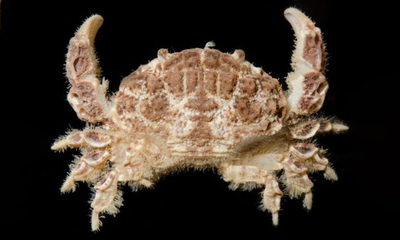
It usually exhibits a dull brown or greenish coloration, which can help it blend into its environment Some individuals may display lighter spots or markings that enhance camouflage against the substrate. The carapace is broad and slightly convex, typically with a rounded shape. It may appear a bit uneven due to various tubercles and ridges. The eyes are large and prominent, situated on stalks that allow for a wide field of vision. This adaptation helps the crab spot predators and prey effectively. The claws are robust and typically asymmetrical, with one claw often larger than the other. The larger claw is adapted for feeding and defense, while the smaller claw assists in manipulating food. It has four pairs of walking legs that are relatively long and slender. These legs are adapted for movement in muddy or sandy substrates, providing good mobility. The pereiopods (walking legs) are well-developed, and equipped with small spines or setae that enhance grip and traction on slippery surfaces. The abdomen is narrow and tapering, which can help differentiate between male and female crabs, with males generally exhibiting a narrower abdomen. The sternum is generally smooth and can help distinguish this species from similar crabs.