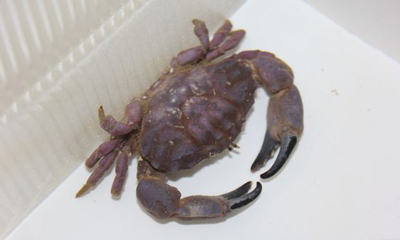
The carapace has a roughly hexagonal form and is smooth, broad, and slightly convex. It has dintinct areas and a slightly grainy texture. In front of the stomach area, there is a noticeable furrow that runs from side to side. The legs and carapace are typically brownish to yellowish, with darker patterns on occasion. Its coloring aids in its integration with the stony beaches and subtidal zones that make up its natural environment. Both claws are about the same size, and the chelipeds are strong and symmetrical. The fingers of the claw are frequently darker than the remainder of the claw, and the claws are smooth with a few granular ridges. The legs used for walking are sturdy, rather lengthy, and have a smooth surface. Their sharp points and the crab’s ability to grip surfaces in its natural habitat. Situated on short stalks that can retract into the orbits for safety, the eyes are comparatively small. In addition, the antennae are small and situated in front of the eyes. Like many crab species, this one has a tiny abdomen that is snugly wrapped under the thorax. It has smooth, segmented edges that fit together tightly. It is a medium-sized crab, with adults commonly having carapace widths of up to 5 cm.