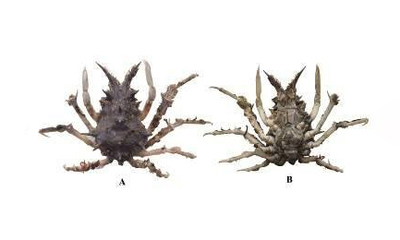
Pyriform in shape, the carapace is convex dorsally and has tiny hooked setae. The carapace’s ventral surface and appendages are whitish, while the dorsal surface is blackish. On the midline of the dorsal surface of the carapace, there are five spines: two acute spines in gastric region, one acute spine in the heart region, and two acute spines on the intestinal line. The branchial area has two long, sharp spines pointing in the directions of the outside and back. Almost as long as the rostrum, with a notably divergent, hairy, and outwards curved rostrum. There are both antorbital and pre-orbital spines, with the pre-orbital spine pointing outward and being marginally longer than the antorbital spine. Short intercalated spine. Strong lobe with a little tubercle located on the hepatic edge and hepatic area. The carpus is short and curved, the merus is twice as long as the carpus, and chelipeds are thin smooth, and not very long. The fingers have small, blunt teeth. Except for the final two pairs of legs, ambulatory legs are thin, longer than chela, and coated in hooka setac.