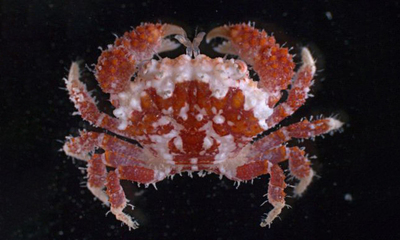
The carapace is spherical, wide, and has a small convexsity. The crab is specifically named “nodulosa” due to its unique rough texture and noticeable grains or nodules strewn throughout the surface. Usually, the anterolateral borders have lobes or teeth that are serrated. Typically, the carapace and legs have colors ranging from reddish-brown to dark brown, with occasional mottling. The chelipeds are strong and often symmetrical, with equally sized claws on each foot. Like the carapace, the claws surface is frequently nodular or granulated. The claws fingers are darker and frequently have black tips. Granules or nodules give the comparatively short and robust walking legs their rough texture. The tips of the short setae on the legs are pointed to help with surface grip. The tiny eyes are protected by retractable stalks that extend into the orbits. Like all xanthid crabs, it has short antennae that are positioned between the eyes. The large, visibly segmented abdomen is snugly folded beneath the thorax.