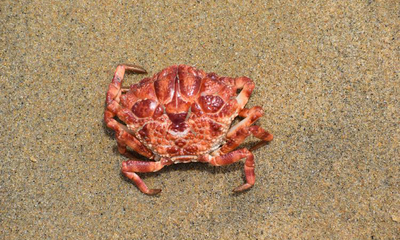
The carapace is large, convex, and rounded to some areas. Usually, it is smooth and has distinct areas There are unique teeth or lobes on the anterolateral edges. The reddish-brown or brown coloration of the legs and carapace aids in the crab’s ability to blend in with its surroundings, which include stony surfaces and coral reefs. Strong and typically asymmetrical, with one claw being larger than the other, are the chelipeds. The smooth claws have distinct tubercles and ridges. The tips of the claws are occasionally black or dark brown, and their fingers are frequently darker than the remainder of the claw. Walking legs are often coated in small setae and have a smooth texture. They are long and thin concerning body size. To help with surface grip, the legs have pointed points. The tiny eyeballs are protected from harm by retracting into their orbits on short stalks. The antennas are situated between the eyes and are quite short. Beneath the thorax lies a small, tightly folded abdomen.