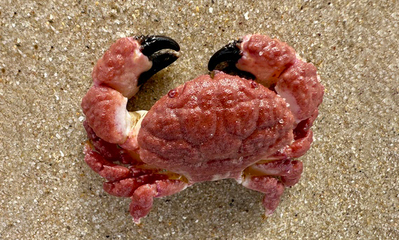
The carapace has a somewhat rounded appearance due to its modest size, which is usually between 2 and 4 cm wide and almost as long as it is wide. Between the eyes, the front of the carapace is either straight or slightly concave. The unique tubercles or nodules that cover the surface of the carapace give it a rough, uneven feel. One of the species’ most defining characteristics is these tubercles. Its ability to blend in is improved by the brilliant coloring of its chelipeds and legs, which frequently matches that of the carapace. Strong and somewhat huge for the body are the chelipeds. Similar to the tubercles on the carapace, they are coated in them as well. The granular surface and curled fingers of the claws are advantageous for handling and grasping food. The crab can move more easily over uneven coral surfaces because of its comparatively short, robust walking legs, which have a slightly flattened appearance. The crab’s rough texture is further enhanced by the setae, which resemble hair, and tubercles that cover the legs. The eyes are located at the ends of rather short, thick eyestalks. There is not much room between the eyestalks.