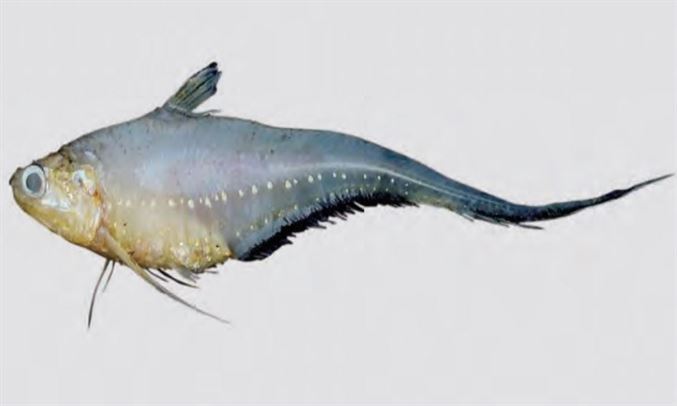
Body tapering, abdomen rounded anterior to pelvic fins; abdomen with
keeled scutes beginning only immediately posterior to pectoral-fin base and continuing to anus; 5
or 6 (rarely 4) prepelvic and 7 to 9 postpelvic scutes; total number of scutes 12 to 15. A small
spine-like scute just anterior to dorsal-fin origin. Maxilla short, not quite reaching posteriorly to margin of
gill cover. Two supramaxillae present; first elongate. Jaw teeth small. Gill rakers fairly short, their serrae
not clumped; lower gill rakers 23 to 26. Branchiostegal rays 10 to 12 (rarely 9). Dorsal fin far forward,
beginning in first third of body length. Anal fin long, with 80 or more fin rays; posteriormost fin ray joined to
caudal fin. Caudal fin very small, extremely pointed. Pectoral fins with upper vi fin rays unbranched, long
and filamentous, reaching posteriorly at least to anal-fin origin, and with 9 to 11 (rarely 8) branched fin rays,
longer than those of pelvic fins and reaching posteriorly at least to pelvic-fin origin. Pelvic fins with i
unbranched and 6 branched fin rays. Isthmus entirely scaled. Striae on anterior part of scales on flanks
sparsely reticulated, with many longitudinal striae anteriorly. Colour: dorsum brown, flanks silvery;
flanks and abdomen with longitudinal rows of golden or pearly spots (light organs, with a pocket
for luminous material and a silvery reflector below) below scales, also along isthmus, along border
of lower jaw, and a few on cheek and gill cover (the disposition of the light organs varying a little between
individuals).