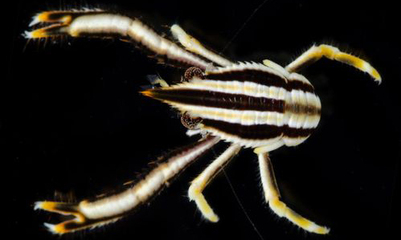
Mostly black or dark brown with bright white or yellow stripes running throughout its body and legs, is renowned for its eye-catching color patterns. It provides good camouflage by blending in with the crinoids it inhabits thanks to their vibrant hues. The striped pattern is constant, while individual colors may differ significantly. As with squat lobsters, the body is flattened and extended. Its small, streamlined form makes it easy to maneuver between crinoids arms. This species is quite small, often growing to a length of 2 to 4 cm. Because of its diminutive size, it can remain concealed among the feather stars’ arms. The upper shell, or carapace, is smooth and thinner toward the front. The species’ two long, thin claws, called chelipods, are frequently striped with black or yellow and white. Despite their delicate look, these claws are effective in grabbing small food items, like as plankton, and are utilized for feeding. The lobster’s exquisite appearance is enhanced by the claws relative elonganon and narrowness concerning the body size. It possesses three pairs of walking legs or pereopods. Additionally, the legs are slim and striped, which facilitates mobility along crinoid surfaces. It may adhere to crinoid arms and other surfaces thanks to the tiny bristles on its legs. Its abdomen is flexible and typically tucked under the body. This improves its maneuverability in confined situations and gives it a more compact appearance. The eyes have a broad range of view because they are stalked and comparatively big. Living among crinoids helps the animal stay vigilant against predators. Picking tiny food particles from the water or the crinoid’s surface is the specialty of the maxillipeds feeding appendages located close to the mouth.