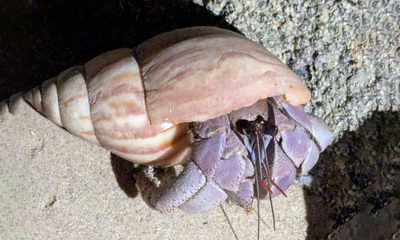
Its violet or purple coloring is its most noticeable characteristic. The larger left claw, the walking legs. and occasionally other exoskeleton components are where this hue is most noticeable. From light lavender to deep purple, the violet hue’s strength can differ from person to person. The carapace has a smooth or somewhat rugose appearance and is spherical and somewhat flattened. In comparison to other hermit crab species, it frequently appears more robust. Because of its asymmetry, one claw typically the right one is larger than the other. While the smaller claw is employed for eating, the larger claw is specialized for defense and object manipulation. It has two antennal pairs. The shorter first pair aids in balance and close-range stimulus detection, whereas the longer second pair is utilized for environmental sensing. The crab’s flexible antennae art essential to its feeding and navigational habits. It has four sets of pereopods or walking legs. The third and fourth pairs are tiny and help grip onto the shell, while the first two pairs are the primary walking legs. The legs can exhibit violet hues like the claws and feature fine hairs to improve grip on a variety of surfaces. The abdomen fits tightly within the shell and is coiled and velvety. Hermit crabs, in contrast to gemine crabs, have a curled abdomen that provides protection when they withdraw into their shells. Since the eyes are on stalks, the crab has a large field of view. It can identify predators and locate food thanks to this. The crab’s eyes are sensitive to movement and light, which enables it to percerve te environment