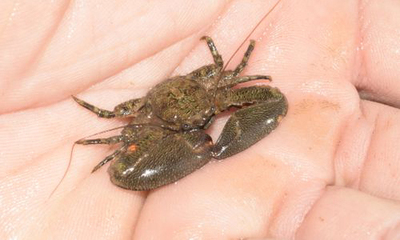
The carapace is smooth, flattened, and rather wide, usually ranging from 1-2 cm in width. It has an oval-like form. Usually greenish to brown, the carapace and appendages have a mottled or speckled appearance that helps with camouflage. Extending beyond the eyes, the rostrum is well-developed and bifurcated or split into two points. One claw is frequently marginally bigger than the other on these massive, flattening chelipeds. They serve as a means of communication, defense, and feeding. The claws may have a granular appearance and are decorated with tiny hairs. The legs used for walking are small and designed to cling to objects and squeeze through small spaces. Reduced and frequently hidden behind the carapace is the final set of legs. With their wide field of view and placement at the front of the carapace, the eyes are on short stalks. The long, thin antennae are employed for sensory perception and cue detection in the surrounding environment.