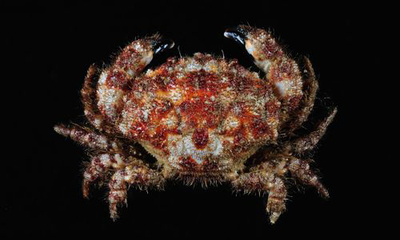
The coloring is often black or dark brown, with lighter patches or mottling. It can effectively blend in with the muddy of sandy soils it usually inhabits thanks to this coloring. Its carapace, which is broadly oval to slightly quadrate in shape, gives it a low profile and stability but aids in navigating its environment. They have strong claws, with one (typically the right) being much bigger than the other. This imbalance facilitates territorial displays, eating, and defense. Usually, the larger claw has a more noticeable gripping mechanism. Since the walking legs are comparatively long and slender, they can travel quickly over rocky, muddy or soft surfaces. To improve traction, the legs may include setae or tiny spines. The large, stalk-mounted eyes have a broad field of view, which is essential for spotting prey and predators. The surface texture of the limbs and carapace may be slightly tuberculated or granular, which helps with grip and predator concealment. In females, the abdomen is wider and tucked under the carapace, which makes it easier to hold eggs during reproduction.