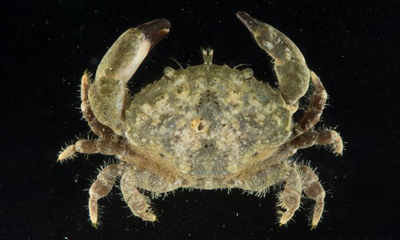
The transversely oval carapace has a smooth, somewhat convex surface. Usually, the anterolateral borders have distinct teeth or lobes and are serrated. The appendages and carapace are frequently dark brown or black, occasionally displaying mottled patterns Its coloring aids in concealment against the stony and coral surfaces on which it typically lives. Strong and slightly asymmetrical, the chelipeds often have one larger claw. They are equipped with tubercles and spines. In comparison to the rest of the body, the moveable fingers of the class are frequently darker in color. The walking legs have small setae covering them and are rather sturdy. Leg tips, or dactyls, are typically pointy, which helps them hold onto objects. The small eyes have a broad field of vision and are positioned atop short stalks The short antennae at situated in the space between the eyes.