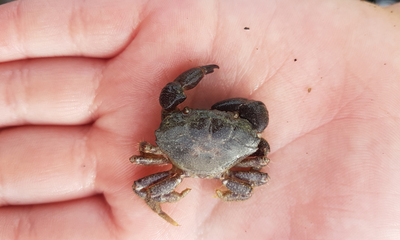
The carapace is large, flattened, and shaped like an oval; its width is normally between 5-8 cm. Its dorsal surface is somewhat convex and has a smooth texture. Against stony soils, the carapace and appendages’ typical dark brown or reddish-brown coloration serves as a good disguise. The carapace’s anterolateral borders are equipped with tiny, sharp spines or teeth that are helpful for identification. The chelipeds have big, asymmetrical claws and are strong. These claws are employed for item manipulation, defense, and feeding. Strong and with keen cutting edges, the chelae are formidable creatures. Strong and designed for gripping and navigating uneven terrain are the walking legs. They have delicate hairs covering them and are rather lengthy. With their large field of vision and placement at the front of the carapace, the eyes are on short stalks. The antennae, which are employed for sensory perception, are sturdy and comparatively short.