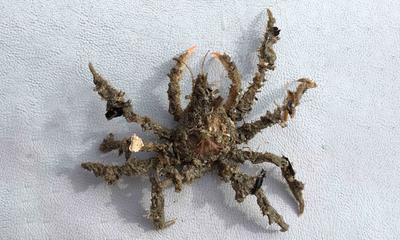
The broad, rounded carapace has a somewhat flattened aspect. It usually has a rough texture covering it, with many tiny tubercles or spines giving it a granular or bumpy surface. Shades of gray, brown, or green are frequently present in the coloring. Effective concealment is provided by this color pattern in its rocky or kelp-dominated habitat. The legs have a good deal of spiky strength. They have evolved to climb and navigate through kelp forests and rocky nooks. The legs are coated in tubercles or spines and have a rough feel. One claw of the chelae is frequently larger than the other, and they are typically large and strong. While the smaller claw may be more sensitive and used for eating, the larger claw serves as protection and manipulation. The rostrum, which protrudes from the front of the carapace, is rather noticeable. It could contain projections or spines, which would enhance the crab’s unique look. With a broad range of view, the eyes are positioned on short, flexible stalks that protrude from the carapace. The crab’s comparatively short and sensitive antennae aid in its ability to detect changes in its surroundings and find food. Numerous tiny spines, or tubercles, cover the crab’s legs and carapace, giving it a rough appearance and further protection and concealment.