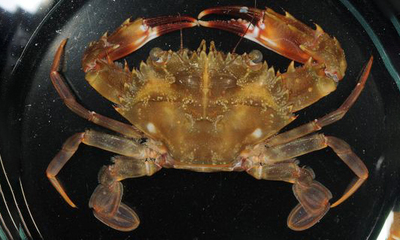
The carapace is broad, somewhat oval, and convex, with a granular surface and well-defined regions typically reddish to reddish-brown. Carapace width ranges from 8 to 13 cm, but can vary depending on the crab’s age and sex. It has nine lateral teeth (spines) on each side, with the ninth spine being the longest and sharpest, forming a noticeable point. Compound eyes are located on short stalks and can retract into their orbits for protection. The legs include a first pair of large, strong claws (chelae), which may be smooth or finely granulated with pointed tips, while the other four pairs are slender and covered with fine setae for movement. The last pair of legs (swimmerets) is flattened and paddle-like, adapted for efficient swimming characteristic of Portunid crabs. The abdomen (pleon) is tucked under the body, narrower in males and broader and rounded in females, which can be used for sex identification. There are visible differences in the abdomen shape, and sometimes in the claw size or coloration, between males and females.