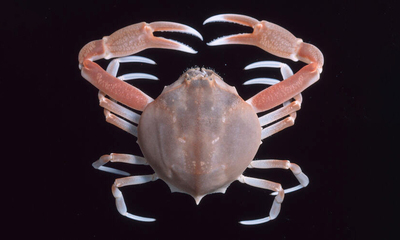
The broad, somewhat spherical carapace has a smooth or faintly granular appearance. It typically has a convex form and is longer than it is wide. The carapace’s surface has distinct portions and is pronounced, smooth, or somewhat granular. The color of the carapace and legs usually varies from brown to reddish-brown, with lighter or darker mottling to help blend in with the natural environment of the species, which is rocky or coral substrates. Both claws are typically around the same size, but one may be slightly larger, and the chelipeds are robust. The claws’ surface is smooth, yet some species have subtle ridges or granulation. Typically, the fingers of the claws are darker and more pointed. Walking legs are quite small, smooth, and somewhat lengthy in relation to body size. They are also occasionally covered in tiny setae. Leg tips are aimed at improving surface grip and movement. Supporting the eyes are short stalks that can retract into the orbits. The antennae of this crab are tiny and located between the eyes, similar to many other xanthids. The huge, neatly folded abdomen under the thorax shows clear segmentation.