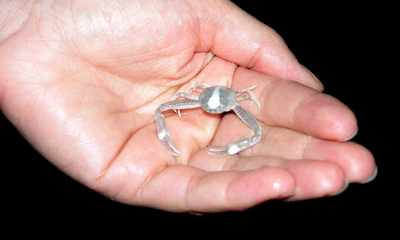
The entire carapace of the fresh specimen is light brownish with white markings. The discoidal carapace has perliform granules on the intestinal, cardial, and branchial areas as well as along the branchio-cardiac grooves and medially on the stomach region. Shallow branchio-cardiac grooves; noticeable granules in the postgastric area. Larger to smaller granules fill the anterolateral and posterolateral borders, whereas perliform granules are tightly spaced in the posterior region and the front crescentic shape. Medially produced anterior border of the epistome. Small eyes fit in orbit, antenna short. Sub-hepatic facet granulates, and a separate lobe characterize the hepatic area. The pterygostomian area is notably granulated, as are the external maxillipeds. Segments 3-6 of the abdomen are basally granular. The carpus is triquetral shaped and granulated; the fingers exhibit a small gap when closed, with the tip of the mobile finger bent on the outside of the immovable finger. The palm is granulated on the backside; the merus is longer than the carapace, and has rows of whitish granules covering its anterior and posterior surfaces. The merus is longer than the carpus and propodus, and the dactylus is sharply pointed at the distal end of the slender ambulatory legs. The first male pleopod was slender and filamentous, with small setae on the lateral sides, apical brush-like plumose setae, and a setose tip; the base’s distal end developed a bulge. The second male pleopod is small, thin, and has an apex scoop shape.