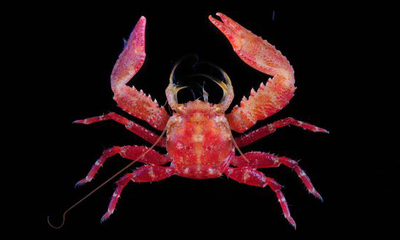
The smooth, broad, and flattened carapace has a typical width of 1-2 cm. Its form is either rectangular or somewhat oval. Usually showing shades of red, orange, or purple, the carapace and appendages can also have complex patterns or dots. Extending forward between the eyes, the rostrum is well-developed and bifurcated. One claw is frequently somewhat larger than the other on these massive, flattening chelipeds. These claws serve as tools for protection, food, and show They may have a grainy appearance and are decorated with fine hairs. The long, thin walking legs are designed for gripping onto surfaces and squeezing through call spaces. The final set of legs is smaller and frequently concealed under the carapace. With a broad field of view, the eyes are positioned on short stalks in front of the carapace. The long, slender, extremely sensitive antennas are employed to pick up on environmental stimuli