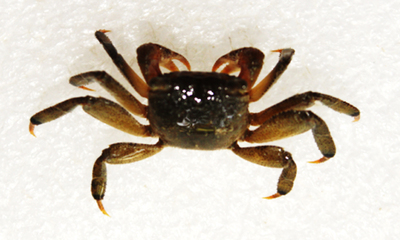
The crab’s natural color range of dark brown to black helps it blend in perfectly with the muddy surroundings of mangrove. The broad quadrangular carapace has a modest convexity. Usually has a breadth of 3 to 5 cm. There are no noticeable spines, and the carapace surface is largely smooth with tiny granulations or punctuations. The chelae are typically paler in color, however, occasionally they have reddish or purplish undertones, especially toward the tips. Like many other mangrove crabs, the claws are symmetrical and of a moderate size. The sharp, pointy points of the claws are useful for handling food because they are adapted to feed on mangrove leaf litter and detritus. The claws are frequently covered with short, fine hairs and may have delicate granulations. The tiny hairs covering the legs may aud in the crab’s movement over mushy, soft substrates and provide sensory feedback. The long, thin, and somewhat flattened walking legs help in swimming in well as walking in maddy conditions. On brief stalks close to the front of the carapace are the eyes. They are suited to the dim lighting of the mangrove habitat and are somewhat small. They have flat, broad abdomens that are closely curled beneath the body To help with egg carry the abdominal flap is wider and rounder in females and narrower and more pointed in male.