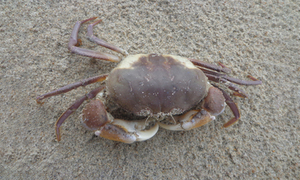
The carapace has a somewhat hexagonal outline and is rather large and slightly convex The carapace’s surface has a rough texture due to granularity or fine tubercles covering it. Compared to other crabs, G. bispinosa usually has a greater number of lobes or teeth on the frontal margin of the carapace. There are a lot of tiny, spherical granules in the lateral areas of the carapace. On each lateral border, there are two or three distinct conical teeth, two of which are always distinguishable. The small, closely spaced eyes are supported by slender stalks. The chelipeds, which are utilized for defense and prey capture, are comparatively large and robust. The surfaces of the chelipeds are finely granulated. Like the carapace, the claws are coated in tiny spines or fine gramiles The color of the claws is frequently darker than that of the body. The long, thin walking legs include setae, or tiny hairs, covering some of its segments Legs are designed to walk on a variety of surfaces, such as rocky and sandy ones. Males have a narrower, more pointed abdomen, while females have a larger, more rounded belly to accommodate their reproductive organs.