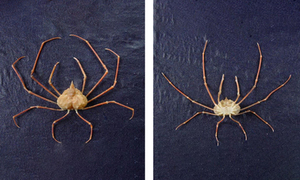
The carapace has a surface that is relatively convex and is shaped like a trapezoid or rectangle. It is longer than it is wide. Its length is usually between 3 and 4 cm, making it tiny in comparison to the legs. Many deep-sea crabs have a rostrum, or forward-projecting appendage, on their catapace that is usually small and pointed. The thin legs are designed for both crawling on the seafloor and carrying things on the back, a trait seen in certain homolid crabs. Fine hairs on the legs may help with holding onto objects or detecting ther surroundings Claws, which are comparatively small and narrow concerning the body size, are created from the finit set of legs. The crab can pick up tiny prey or debris from the seafloor thanks to the often-poimed points of its claws. At the front of the carapace, on slender stalks, are the comparatively small eyes