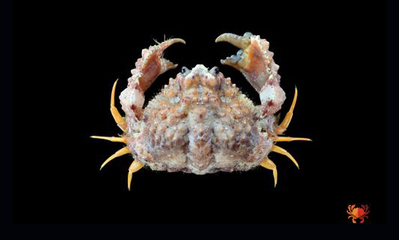
The broad, convex, approximately oval carapace gives the crab a hos-like look. Many spines or tubercles cover the surface of the carapace, with the most prominent ones being close to the margins. Adult specimens usually measure between 7 and 12 cm wide, with the carapace being wider than the length.The legs and carapace are typically light brown to yellowish, with occasional blotches or reddish or brownish markings. There may be a contrast between the lighter backdrop and the darker-colored spines and tubercles.C. gallus possesses five pairs of legs, the first of which has been altered to become strong, enormous claws (chelae). To help in movement and digging, the walking legs are robust, short, and coated in tiny spines called tubercles.One paw is noticeably bigger than the other, and they are both big, broad, and asymmetrical.Since the abdomen is folded beneath the body, it is typically hidden from view from above. To allow for holding eggs, the abdominal flap is larger and rounder in females and thin and pointed in men.The small eyes are situated close to the base of the claws at the front of the carapace on short stalks . The claws and the protruding margins of the carapace provide good eye protection.