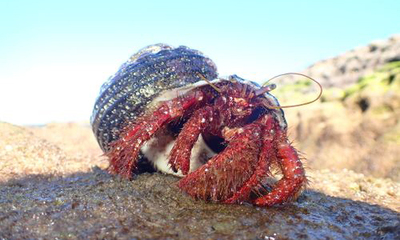
It has strikingly vivid coloring. The legs and claws generally have white or cream patches or bands, whereas the body is frequently bright red, orange, or brownish-red. The crab looks distinctive because of this pattern, especially in its natural habitat. Usually, white or pale rings are used to band the legs, which contrast with the darker reddish background. The carapace is broudly oval and somewhat flattened, with a smooth surface that may exhibit a few tubercles or ridges. It has a robust and sturdy appearance. Its broad, uneven claws are its most noticeable trait. The crab seems noticeably asymmetrical because its right claw is relatively bigger and stronger than its left. The first two of its four walking leg pairs are the biggest and strongest, while the latter two are smaller and aid in the crab’s ability to grasp the inside of the shell. Following the pattern on the claws, the legs are speckled or banded in reddish-brown and white hues. Large, black eyes are located at the tips of long, thick eye stalks. As these eyeballs can move, the crab can see a large area, which helps it find food and identify potential threats. In comparison to the rest of the body, the eye stalks are frequently pale or light-colored, occasionally with a faint reddish undertone. It has two antennal pairs. While the shorter first antennae are used to detect food and nearby stimuli, the longer second antennae are utilized to sense their surroundings. The crab’s vibrant coloring is enlanced by its usually orange or crimson antennae . It needs protection from a shell because of its fragile, curled abdomen. It has a lengthy body that fits snugly inside the shell it decides to live in.