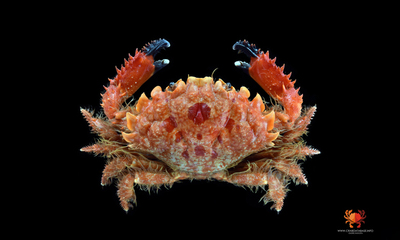
This species is renowned for its eye-catching coloring, which usually consists of vivid orange, red or yellow patterns with darker markings or patches. Its vivid coloring acts as camouflage against the stony substrates and corals in its surroundings. Its flattened appearance and large, somewhat oval carapace aid in as ability to move across environment. Strong and asymmetrical, with one claw larger than the other, the claws are designed for both protection and feeding. The larger claw is used to capture prey and is frequently more noticeable. Because the walking legs are long and thin, they can move quickly over rough and uneven terrain. They could have tiny spines that help them stay in place. The well-developed eyes, which are mounted on stalks, have a wide range of view that allows them to identify both prey and predators. The small and slightly flexible abdomen aids in hiding among corals or digging into cracks to aviond predators. The species can be distinguished from other similar crabs by its relatively smooth sternum. To help with camouflage against the substrate, the legs and carapace may have a smooth surface with faint granulations.