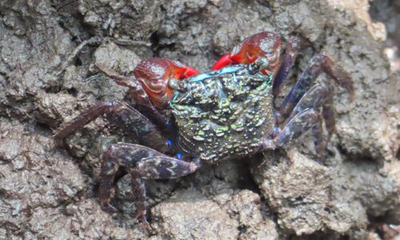
The carapace is frequently rather hexagonal or oval in shape, and it is relatively broad and slightly flattened. It normally has a smooth surface or may have slight grainy textures. The pigmentation often ranges from light brown to gray or greenish-brown, which is an adaptation for concealment in its environment. It often has patterns or mottling that assist the crab to blend with its environment. The rostrum is normally tiny and not very conspicuous, projecting slightly forward from the front of the carapace. The legs are slim and extended, well-adapted for climbing and moving through mangroves or rocky regions. They are coated with tiny hairs or little spines. The chelae are frequently asymmetric, with one claw larger than the other. The larger claw is sturdy and utilized for defense and manipulation, whereas the smaller claw is more sensitive. The eyes are situated on short, stalk-like extensions extending forth from the carapace, offering a wide field of vision. The antennae are small and sensitive, helping ecological sensing and hunting.