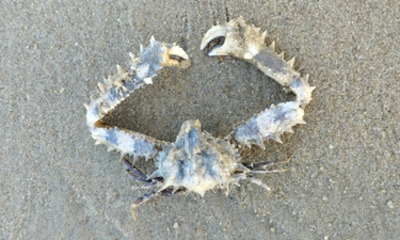
Usually large and flat, the carapace has a rough texture. It typically has tubercles or tiny spines covering it, which aids in camouflage. The tint varies but generally corresponds with the seabed; it has mottled patterns and tones ranging from brown to reddish to help it fit in with the surroundings. Prominent and extending forward from the front of the carapace is the rostrum. Usually, it has extensions that resemble beaks or spines. Ten pairs of legs make up the crab. The first pair are strong chelae, or claws, which are employed for both defense and feeding. Mobility is aided by the comparatively long and slender remaining legs. One claw on the chelae is frequently larger than the other, resulting in asymmetry. Their texture is granular, and they could have teeth or tiny spines to help them grab prey. The eyes have a broad field of vision and are on stalks that protrude from the carapace. Usually, the eye stalks are strong and short.