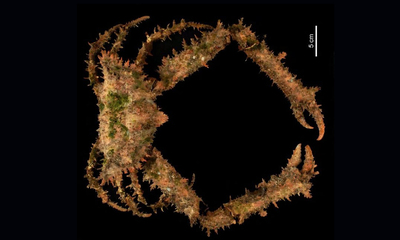
The surface of the broad, somewhat flattened carapace is smooth to slightly grainy. The carapace is often wider than longer and has many noticeable tubercles or spines that give it a unique rough appearance. Typically, the coloring consists of reddish-brown or brown tones. To help with camouflage in its native habitat, the carapace and legs frequently have a mottled or patterned look. With one claw usually larger than the other, the chelipeds are strong and frequently asymmetrical. The chelipeds’ merus and propodus are narrow. The long, thin walking legs have a rough texture because they have tubercles or spines on them. The legs’ pointy tips facilitate mobility on rocky or coral substrates. Situated on short, retractable stalks that can be pulled into the orbits for protection, the eyes are comparatively small. The short antennae are situated in the space between the eyes. The abdomen is clearly segmented, small, and snugly folded beneath the thorax. Numerous crab species share this structure, which shields the reproductive organs. It can be easily identified from other species that are similar due to its chelipeds and heavily spined carapace.