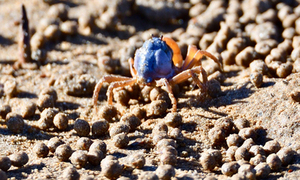
The carapace is usually broad and shaped like an oval or hexagon. It frequently has relatively flat sides, a slightly elevated center, and a smooth or slightly grainy texture. The comparatively long and slender legs are designed for walking and burrowing on muddy or sandy soils. They frequently have a slight flattening and are typically coated in fine hairs. Usually, one claw on each chelae is larger than the other, resulting in asymmetry. Their main functions are protection and feeding, and they are robust. The larger claw may be rougher-textured and frequently more prominent. Typically, the rostrum is tiny and barely noticeable, protruding from the front of the carapace. The eyes’ broad field of vision and ability to detect movement in their environment is facilitated by their short stalks. Due to their small length and sensitivity, the antennae help with foraging and environmental sensing. Small tubercles or spines on the legs and carapace may help the crab blend in with its surroundings and provide some protection.