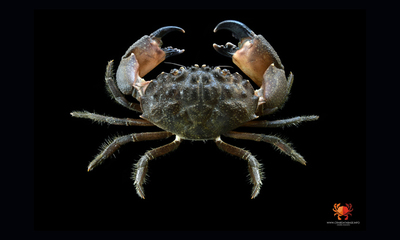
The carapace has a smooth to granular appearance and is either broadly spherical or slightly hexagonal. It is rather flat with well-defined borders and a somewhat ridged or spiky look. Usually short and barely noticeable, the rostrum protrudes slightly from the front of the carapace. It could contain spines or very small projections. The legs are strong, the front pair being noticeably bigger and stronger than the others. One chelae is noticeably bigger and more robust than the other, resulting in an asymmetrical chelae. The smaller claw is more sensitive and frequently employed for fine manipulation, while the bigger claw serves defensive and foraging purposes. Short stalks that protrude from the carapace hold the eyes in place. The crab’s comparatively short and sensitive antennae aid in its ability to sense environmental changes and identify potential food sources.The carapace and legs are examples of body surfaces that may feature tiny spines, tubercles, or fine hairs for protection and concealment.