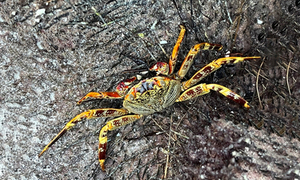
The carapace is typically hexagonal or oval in shape, and it is relatively broad and slightly flattened Ite texture is rather even, and its surface is either smooth or finely granular. Typically, the carapace has noticeable lateral expansions and is wider than long. From green to reddish-orange, the colors are usually vivid and bright, frequently with contrasting patterns or dots. Strong and frequently asymmetrical, with one claw being larger than the other, are the chelipeds. Their smooth surface is sporadically covered in tubercles or granules, and their claw fingers are pointy and sharp, designed for both defense and feeding. The walking legs have a smooth or somewhat grainy appearance, and they are comparatively long and slender. The tips of the legs are pointed for improved grip, and they are well-adapted for mobility se rocky surfaces and climbing. Situated on brief, retractable stalks that can be pulled into the orbits for protection, the eyes are comparatively large. The short antennae are situated in the space between the eyes. The abdomen is clearly segmented, small, and snugly folded beneath the thorax.