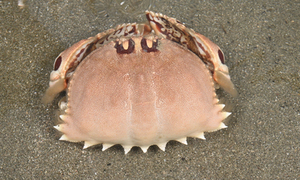
The large, oval, strongly convex carapace gives the appearance of a box. It is distinguished from other species in the genus by its smooth carapaces, which have either few or no spines. Adult specimens usually measure between 8 and 12 cm wide, with the carapace being wider than the length. Its five pairs of legs are transformed into broad, massive claws called chelae on the first pair. The comparatively small and robust walking legs are more adapted to crawling and digging than swimming. The final set of legs is shorter, more suited for walking, and frequently tucked beneath the body to help with burrowing. The claws are broad, massive, and noticeably asymmetrical, with one being remarkably bigger than the other. As is common with crabs, the abdomen is folded beneath the body. The purpose of the female’s larger, rounded abdomen flap is to contain eggs, whereas the male’s is narrow and pointed. At the front of the carapace, close to the base of the claws, are the small eyes on short stalks. When folded, the claws and the expanded frontal border of the carapace provide good protection for the eyes.