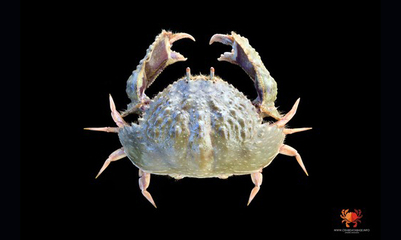
The crab has a box-like appearance due to its broad, oval, and extremely convex carapace. It is smooth on the outside, with tiny tubercles or fine granulations around the borders. Adult specimens’ carapaces typically measure between 5 and 8 cm wide, making them wider than long. Typically, the ventral side of the body has a paler hue, such as white or pale yellow. Five pairs of legs make up C. hepatica, the first of which has been altered to become broad, massive claws (chelae). The walking legs are robust, short, and somewhat flattened, with fine hair fringes along the edges. The final set of legs is smaller and usually tucked under the carapace; it is designed more for digging than for swimming or walking. Huge, strong, and noticeably asymmetrical, one claw is usually bigger and more potent than the other. Folding of the abdomen beneath the body is a frequent feature of crabs. The abdominal flap, which is intended to hold eggs, is larger and rounder in females and thin and pointed in males. The small eyes are situated close to the base of the claws at the front of the carapace on short stalks. The claws, when folded, and the protruding margins of the carapace provide good protection for the eyes.