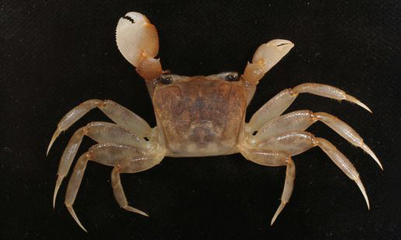
The carapace has a slightly convex surface and is almost square. With a breadth of about 4-6 cm, wider than it is long. The carapace’s surface is largely smooth, with a few tiny ridges or minute granulations. The first pair of legs is converted into claws, or chelae, while the other four pairs are designed for rapid mobility. The long, slender walking legs have small hairs covering them, which helps them travel quickly over sandy terrain. Because of its well-adapted legs for digging, the crab can dig burrows swiftly. The asymmetrical, huge claws usually have one larger than the other. Its smooth texture and possible orange or red tinge at the tips are what give rise to the common moniker “red ghost crab.” It is a giant crab with a broad range of vision because of its huge eyes, which are set on conspicuous stalks. The eyes of the crab are often known as “horn-eyed” because they can protrude far above the shell, giving the creature a unique look.