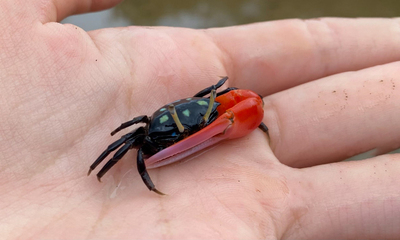
The carapace is somewhat convex, squarish, and broad. It has no noticeable ridges or spines and is smooth. The carapace has lighter spots or mottling and is frequently brilliantly colored, ranging from orange to red or occasionally brown. The surroundings can have a significant impact on the hue. Males display pronounced sexual dimorphism, where one cheliped is significantly larger than the other and serves a more functional purpose in feeding The two little, equal-sized claws on females are symmetrical. The male’s main chela is big, strong, and frequently colorful, usually in orange, red, or yellow tones. The eyes are located at the tips of long, slender eyestalks. The eyestalks are separated by a fair amount of space. Usually darker, the legs may have lighter areas near the joints. The walking legs have smooth surfaces and are comparatively long and slender. They frequently have dark colors that blend in with the carapace’s tint.