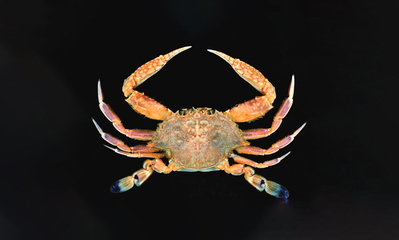
The carapace is smooth, broad, and hexagon-shaped. It has also been substantially flattened. The carapace comprises distinct areas and is wider than it is long. The posterior lateral edges expand into sharp spines, while the anterolateral borders are serrated with teeth. Usually reddish-brown or reddish-orange in color, the carapace and legs have white or light-colored patches or patterns. One claw on each of the sturdy, somewhat long chelipeds is frequently bigger than the other. The claws’ digits are typically dark in color and frequently have black tips. Walking legs are flattened and comparatively lengthy, as they are designed for swimming. Swimmerets are flattened. paddle-like appendages that are modified from the last pair of legs (the fifth pair) to help with swimming. The tiny eyes are protected from the elements by being brought into the orbits using long, retractable stalks. The short antennae are situated in the space between the eyes. The abdomen is clearly segmented, small, and snugly folded beneath the thorax. Numerous cri species share this characteristic, which shields the reproductive organs.