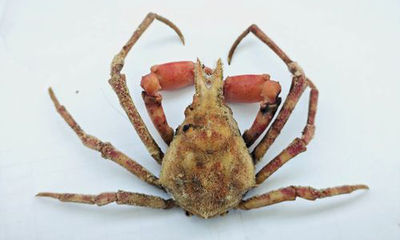
The crab can blend in wuh its surroundings because of its normally dull coloring, which is frequently brownish or greyish. Its concealment is further enhanced by the environmental elements used to decorate it. The carapace tapers toward the anterior end (front) and is long and nearly triangular. It has a rough texture since it is frequently coated in spines. Its carapace’s noticeable spines or tubercles are one of its identifying characteristics. The fact that these spines are usually grouped or pured unproves their capacity to blend in with the surroundings. As is common in many spider crabs, the rostraan is bifurcated, with two sharp spines pointing forward. The comparatively long and slender walking legs facilitate mobility on rocky or coral reef surfaces. The crab’s legs are frequently decorated with setae, which resemble hairs and enable it to affix creatures or trash to its body. To blend in with its surroundings, it frequently adorns its carapace with sponges, algae, or other tiny aquatic life To evade predators, this activity is an essential survival tactic. Small eyes are usually well suited to spotting movement in murky water Furthermore, when the crab hides in cracks or tries to blend in with the nearby sponges and plants, the eye stalks can partially retract offering protection