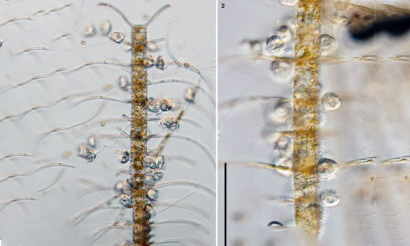
The cells have a cylindrical shape and appear elliptical when viewed from the valve. These cells are organized into long and robust chains, with two distinctly different ends. They typically measure 30-44 µm in width, with very small apertures. The valve surface is flat and possesses a relatively high mantle, which spans one-third to two-thirds of the apical axis. There’s a more or less deep, but always noticeable constriction at the suture where the mantle meets the girdle band.The posterior terminal setae are relatively large, strongly curved, heavily spined, and shorter than the others. In contrast, the anterior terminal setae are less robust, curved toward the posterior end, and have lighter spines. The setae located in the center of the chain are curved similarly to the anterior terminal setae and have spines. These setae have rows of fine puncta running lengthwise, typically visible only on the posterior terminal setae, where they appear in double rows.